A roof problem rarely arrives at a convenient time. One day, everything looks fine. Then a heavy rainstorm reveals a ceiling stain, a few shingles appear in the yard, or a small leak starts dripping into the attic.
Suddenly, you’re facing a big question: Should you repair the damage or replace the entire roof?
The answer isn’t always as simple as choosing the cheaper estimate. A relatively inexpensive repair can be a smart investment when the rest of the roof is in good condition. But if your roof is approaching the end of its useful life, repeatedly paying for repairs could cost more than replacing it altogether.
The trick is understanding the condition of your existing roof, the extent of the damage, and how long each option is likely to serve you.
Here’s how to compare roof repair vs. roof replacement, recognize the warning signs, and make a decision that protects your home without putting unnecessary pressure on your budget.
Roof Repair vs. Roof Replacement: What’s the Difference?
Before comparing costs, it helps to understand what each project involves.
What roof repair typically includes
Roof repair focuses on fixing a specific problem without replacing the entire roofing system. Depending on the damage, a contractor might:
- Replace a handful of missing or cracked shingles.
- Repair damaged flashing around chimneys, vents, or skylights.
- Seal certain roof penetrations where appropriate.
- Fix a localized leak.
- Repair a small area of damaged underlayment or roof decking.
- Correct problems with roof drainage or other components.
Repairs generally cost less upfront and can extend the useful life of a roof that’s otherwise performing well.
What roof replacement involves
Roof replacement means removing some or all of the existing roofing materials and installing a new roofing system, depending on the project’s scope.
A full replacement may include new shingles or other roofing materials, underlayment, flashing, drip edges, and repairs to damaged roof decking. The contractor may also address ventilation or drainage problems contributing to premature deterioration.
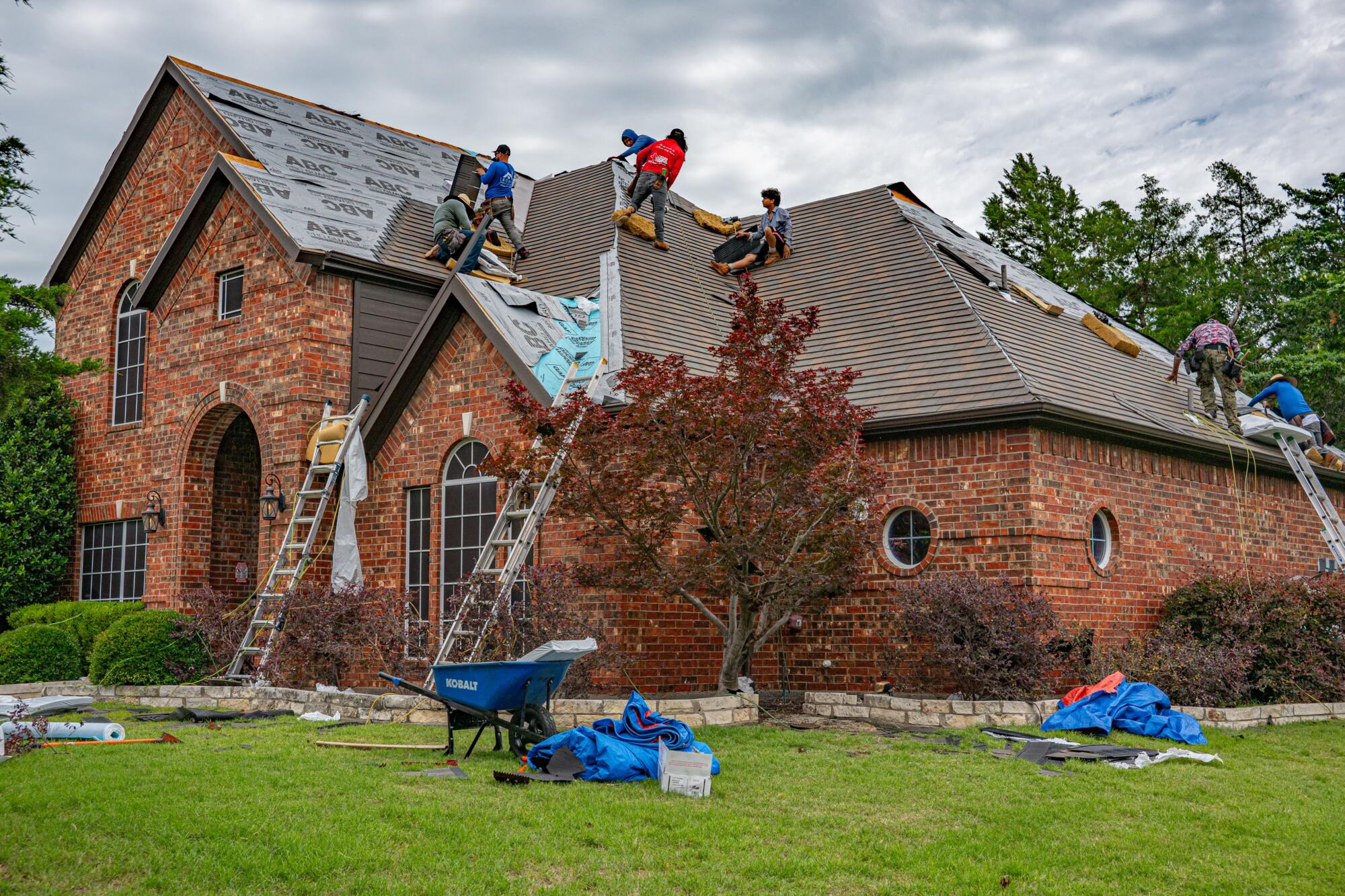
The featured image shows this type of larger roofing project in progress, with workers installing materials across multiple sloped sections of a brick home’s roof.
Replacement requires a bigger initial investment, but it can resolve widespread deterioration and reduce the likelihood of continued repairs when the underlying problems are addressed properly.
How Much Does Roof Repair vs. Replacement Cost?
Cost is often the first consideration for homeowners, and for good reason. However, the price difference depends on roof size, material, accessibility, pitch, labor rates, and the extent of any hidden damage.
For a general U.S. budgeting reference, published Angi estimates place many roof repairs in the hundreds to low thousands of dollars, while full roof replacements commonly cost several thousand dollars to well over $10,000. Complex roofs, premium materials, structural repairs, and difficult site conditions can increase those figures considerably.
These are broad planning ranges, not quotes. Local prices and actual project requirements can differ substantially.
When a repair offers better value
A repair is usually the more economical choice when the damage is limited and the remaining roof is in good condition.
For example, imagine a relatively new asphalt-shingle roof that loses several shingles during a windstorm. If the surrounding shingles, underlayment, flashing, and decking remain sound, replacing the damaged section may restore protection without the expense of a full replacement.
The same principle applies to isolated flashing failures and localized leaks that can be traced to a specific, repairable problem.
The key: You’re paying to fix a defined issue rather than replacing materials that still have useful life remaining.
When replacement may save money over time
A full replacement can make better financial sense when the roof has widespread wear, recurring leaks, or several deteriorating areas.
Consider a roof that needs another repair every year. Each individual invoice might seem manageable, but repeated labor charges, temporary fixes, interior water damage, and emergency service fees can add up.
Replacement may cost substantially more today, but it can eliminate multiple sources of failure at once and provide a more predictable maintenance outlook.
Before committing, ask your contractor to compare the cost of the proposed repair, the likely remaining roof life, and the expected scope of future work.
Five Signs Your Roof May Need Replacement
Some roofing problems are isolated. Others indicate that the entire system is wearing out.
Watch for these warning signs.
1. Your roof is approaching the end of its expected lifespan
Roofing materials age at different rates. Many asphalt-shingle roofs last roughly 15 to 30 years, depending on the product, installation quality, ventilation, maintenance, and climate. Metal, tile, and slate systems can last considerably longer under suitable conditions.
Age alone doesn’t automatically mean you need a new roof. However, an older roof with visible deterioration deserves closer inspection.
If your roof is nearing the end of its expected service life and developing repeated problems, start comparing replacement estimates before an emergency forces the decision.
2. Leaks keep appearing in different locations
A single leak may result from damaged flashing, a loose shingle, or another localized issue.
Multiple leaks appearing in separate areas can suggest broader deterioration. If repairs repeatedly solve one problem only for another to appear elsewhere, ask a qualified roofer whether the roofing system is nearing the end of its useful life.
Remember that ceiling stains don’t always appear directly below the entry point. Water can travel along roof decking and framing before becoming visible indoors.
3. Shingles show widespread deterioration
Look for widespread curling, cracking, missing shingles, bald patches, or excessive granule loss.
A few damaged shingles don’t necessarily justify a replacement. However, if these conditions affect large portions of the roof, repairing individual areas may become less practical.
Granules accumulating in gutters can be a clue, although some granule loss is normal as shingles age. Have a professional evaluate the overall condition rather than relying on one symptom.
4. The roof is sagging or the decking is damaged
A sagging roofline, soft or deteriorated decking, or evidence of structural damage requires prompt professional assessment.
These issues can involve more than the visible roofing material. Water intrusion may have affected the underlying wood, framing, or other structural components.
Don’t assume that new shingles alone will solve the problem. The source of moisture and any damaged supporting materials must be addressed.
5. Repairs are becoming increasingly frequent
One repair doesn’t necessarily signal trouble. A pattern of repeated service calls is more telling.
If you’re constantly replacing shingles, patching leaks, or dealing with new areas of deterioration, compare your cumulative repair spending with a complete replacement estimate.
A roof that repeatedly needs attention may still be repairable, but the financial case for replacement becomes stronger when the existing system has limited useful life remaining.
When Roof Repair Is the Smarter Choice
Replacement isn’t automatically the better option simply because a roof has a few problems.
Repair often makes more sense in these situations:
- The damage is localized. A small number of damaged shingles or a specific flashing failure can often be corrected without replacing the entire roof.
- The roof is relatively young. A roof with substantial useful life remaining may justify targeted repairs.
- The underlying structure is sound. If the decking and other components remain in good condition, the repair can address the actual problem.
- The leak has a clear, repairable cause. Fixing a specific point of water entry may be all that’s needed.
- You need time to budget. A properly performed repair can sometimes protect the home while you prepare financially for a planned replacement.
That last point deserves attention. If replacement is likely within a few years, a repair may still be worthwhile, but only if the contractor explains what it will accomplish and how long it is reasonably expected to last.
Avoid spending money on a temporary fix without understanding whether it will provide meaningful protection.
How to Calculate the Long-Term Cost of Your Roof
The lowest estimate isn’t always the least expensive option over time.
To compare repair and replacement fairly, look beyond the immediate invoice.
Step 1: Calculate the cost of repairing the roof
Add the proposed repair cost to any other likely expenses, such as recurring inspections, related repairs, and damage that may occur if the underlying issue isn’t fully resolved.
For example, a $900 repair may be excellent value if it fixes an isolated problem on a healthy roof. The same repair may be less attractive if another $1,200 repair is likely within a few months.
These figures are illustrative, not typical prices or predictions.
Step 2: Estimate how long the repair will last
Ask the contractor to explain the expected service life of the repair and the condition of the surrounding roof.
A repair that buys several useful years can be financially sensible. One that only delays a necessary replacement briefly may offer less value.
Step 3: Compare the full replacement cost
Request a written replacement estimate that identifies the materials, labor, underlayment, flashing, disposal, decking allowances, and any additional work.
Make sure you’re comparing similar scopes of work. A low estimate that excludes likely decking repairs isn’t directly comparable to a comprehensive proposal.
Step 4: Consider the cost per year
A simple way to compare options is to divide the expected cost by the number of years of service.
Suppose a repair costs $1,200 and is expected to provide three additional years of service. That’s an illustrative cost of $400 per year.
Now suppose a $12,000 replacement provides 20 years of service. That’s $600 per year.
On those simplified figures, the repair has the lower annual cost. But the comparison doesn’t include future repairs, inflation, financing, maintenance, or the possibility that the repair won’t last as long as expected.
The useful lesson is to compare realistic scenarios rather than assuming that a repair is always cheaper or that replacement always offers better value.
Step 5: Account for the consequences of waiting
Water entering the home can damage insulation, ceilings, flooring, belongings, and structural materials. Persistent moisture can also contribute to mold growth.
The U.S. Environmental Protection Agency emphasizes the importance of controlling moisture and correcting water intrusion to limit damage.
If a repair can reliably stop an active leak, it may be worth doing promptly even when replacement is also under consideration. Protecting the home comes first; the larger financial decision can follow once the immediate problem is controlled.
How Long Should a Roof Last?
Expected roof life depends on the material and the conditions in which it operates.
Here are broad planning ranges commonly cited for residential roofing:
- Three-tab asphalt shingles: Approximately 15–20 years.
- Architectural asphalt shingles: Approximately 20–30 years.
- Metal roofing: Often 30–70 years or longer, depending on the system.
- Clay or concrete tiles: Often 50 years or more when properly installed and maintained.
- Slate roofing: Potentially many decades, sometimes more than a century, depending on the slate and installation.
These are general estimates, not guarantees. Product specifications, installation, weather exposure, ventilation, maintenance, and the condition of supporting components all influence actual performance.
A roof in a region exposed to intense sun, heavy rainfall, high winds, or repeated storms may age differently from a comparable roof in a milder environment.
If you’re unsure how much life remains, look for installation records, product warranties, previous inspection reports, and repair invoices. A professional inspection can help establish a practical maintenance or replacement timeline.
Smart Ways to Budget for Roof Repair or Replacement
Roof work can be expensive, but a little planning makes the cost easier to manage.
Schedule inspections before problems become emergencies
Have the roof assessed periodically and after significant storms. Homeowners should avoid walking on steep or slippery roofs; a qualified professional can inspect hard-to-reach areas safely.
Early detection can reveal damaged flashing, loose materials, drainage problems, or small leaks before they develop into larger repairs.
Maintain gutters and drainage
Keep gutters and downspouts clear, and make sure water drains away from the house as intended.
Blocked drainage can contribute to water backing up beneath roofing materials or overflowing near vulnerable parts of the home. Trim branches that threaten the roof and remove debris when it is safe to do so.
Build a dedicated roofing reserve
Instead of waiting for a leak to create an emergency, set aside money regularly for roof maintenance and eventual replacement.
Your target should reflect the roof’s age, material, size, condition, and local replacement costs. An older roof generally deserves a more urgent savings plan than a recently installed one.
Get multiple written estimates
Compare at least two or three qualified contractors when practical.
Each estimate should explain the recommended work, materials, warranty terms, payment schedule, cleanup, and how unexpected damage will be handled.
Ask why the contractor recommends repair or replacement. A reliable professional should be able to explain the evidence behind the recommendation rather than simply pushing the most expensive option.
Review warranties and insurance coverage
Check your roofing warranty and homeowners insurance policy before paying out of pocket.
Coverage depends on the policy, the cause of the damage, exclusions, and other circumstances. Normal wear and deterioration are commonly treated differently from sudden covered events.
Document storm damage with photographs from a safe location, retain estimates and receipts, and contact your insurer promptly if you suspect a covered loss. Don’t assume that insurance will pay for a full replacement.
Conclusion: Which Option Saves More Money?
So, roof repair vs. roof replacement—which is the better financial decision?
Repair is usually the more economical choice when damage is limited, the underlying roof remains sound, and substantial useful life remains. Replacement becomes more attractive when deterioration is widespread, leaks recur, structural components are affected, or repair costs continue to accumulate.
The best decision starts with an accurate assessment of the entire roofing system, not just the most visible problem.
Get a professional inspection, compare written estimates, and ask how long each option is expected to last. Consider both today’s expense and the likely costs of future maintenance.
Most importantly, don’t ignore an active leak while deciding what to do next. Address water intrusion promptly, then use the information you gather to plan a durable, budget-conscious solution.
A well-timed repair can save money. A well-planned replacement can prevent years of recurring problems. The goal is to choose the option that delivers reliable protection and the best long-term value for your home.