
Introduction
Most homeowners are used to seeing the occasional hairline crack, a little peeling paint, or a door that needs an extra push to close.
Not every imperfection is a structural emergency. Homes naturally settle, building materials expand and contract, and finishes can develop small cracks as they age. In fact, the National Association of Home Builders notes that many common cracks are cosmetic rather than structural.
The tricky part is knowing when an ordinary-looking problem deserves more attention.
A crack that grows, a floor that suddenly feels uneven, or several doors that begin sticking can sometimes point to movement in the foundation or framing. The American Society of Home Inspectors identifies uneven floors, wall cracks, poorly operating doors and windows, and other changes as potential indicators of foundation or structural problems.
The key is to look for patterns rather than isolated imperfections.
Here are some of the warning signs homeowners should know.
1. Large or Growing Foundation Cracks
Cracks are among the most obvious signs that something may be changing beneath or around a home.
Small, stable cracks can occur for many reasons, including normal shrinkage and seasonal movement. But cracks deserve closer attention when they are noticeably widening, extending over time, or accompanied by other signs of movement.
Pay particular attention to:
- Wide cracks in foundation walls
- Long cracks that continue across multiple materials
- Cracks with visible vertical or horizontal displacement
- Stair-step cracking in masonry
- Horizontal cracks in basement or foundation walls
- Cracks accompanied by water intrusion
- Multiple cracks appearing in the same area
HUD inspection standards specifically identify cracks in foundations along with indicators such as wall cracks, non-functioning doors, and unlevel floors as conditions that warrant inspection.
That doesn’t mean every crack requires foundation replacement. The pattern and surrounding conditions matter.
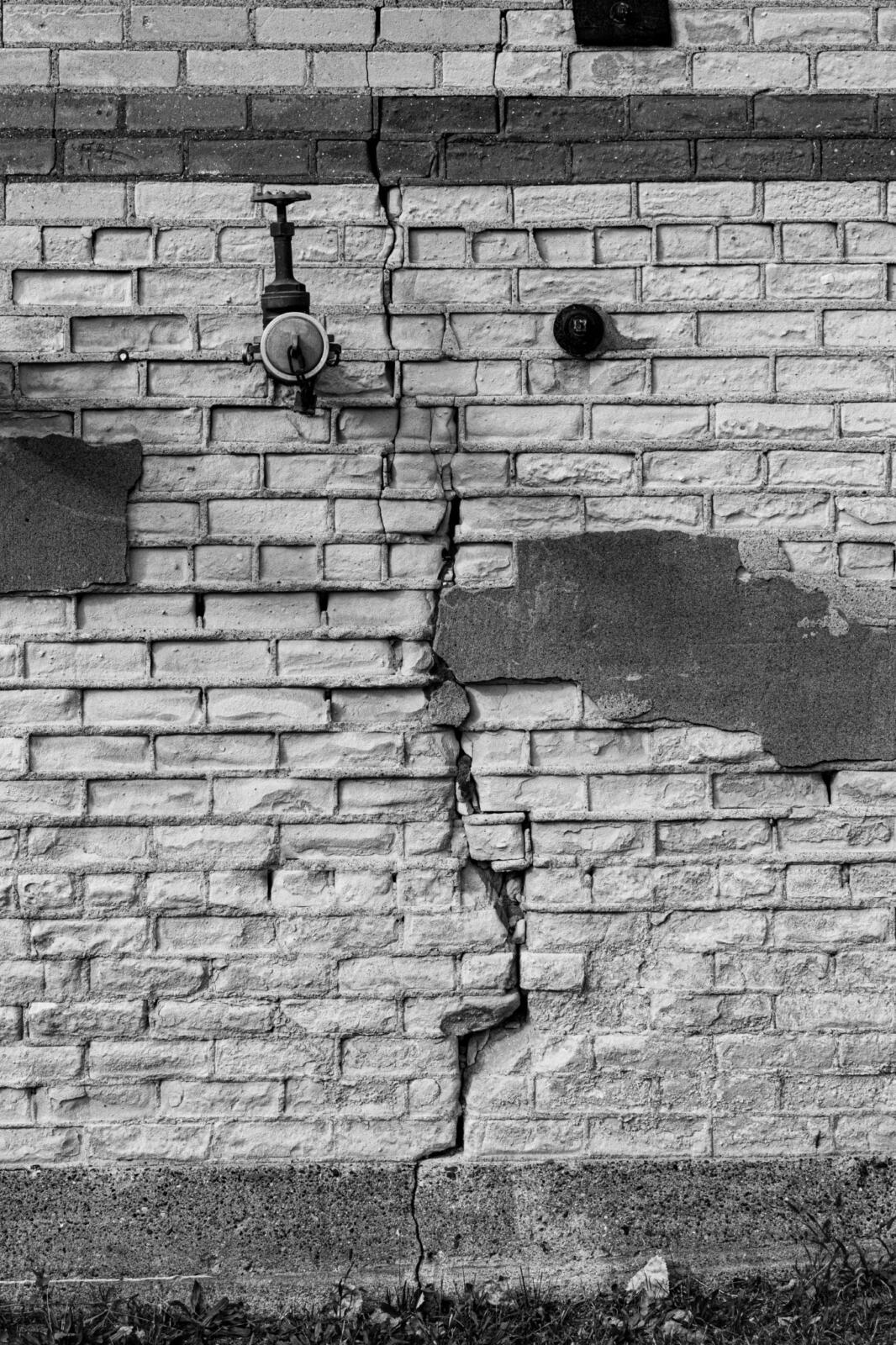
What about the crack in the featured image?
The photograph shows a particularly noticeable vertical crack running through an exterior brick wall. There is also visible separation and damage around portions of the masonry.
That’s enough to justify a closer inspection—but not enough, by itself, to diagnose structural failure.
A professional would want to know whether the wall has shifted, whether the crack is active, whether similar cracking exists elsewhere, and what is happening at the foundation below.
2. Uneven, Sloping, or Bouncy Floors
Your floors can provide clues about what’s happening beneath them.
A floor that has always had a slight slope may simply reflect the original construction. A noticeable change, however, is more interesting.
Watch for:
- Furniture that suddenly seems to tilt
- A ball or toy consistently rolling in one direction
- New gaps beneath furniture
- Floors that feel unusually bouncy
- A noticeable slope across a room
- Changes that seem to be getting worse
Differential settlement—the situation where one portion of a foundation moves differently from another—can contribute to out-of-level floors and walls that are no longer plumb.
Uneven floors can also come from damaged framing, moisture-related deterioration, or other non-foundation issues. That’s why identifying the symptom is only the first step.
3. Doors and Windows Suddenly Start Sticking
A door that sticks in humid weather isn’t necessarily a structural problem.
But what if several doors suddenly become difficult to open or close?
Or a window that worked perfectly for years now rubs against its frame?
Changes in door and window operation can sometimes accompany foundation movement or shifting around openings. HUD and ASHI inspection guidance both recognize poorly functioning doors and windows as potential indicators that deserve attention when they occur alongside other structural symptoms.
Look for a pattern.
If one old wooden door sticks during the summer, moisture may be the simple explanation. If several doors and windows throughout the house change at roughly the same time, it’s worth investigating further.
4. Walls Begin Separating From Ceilings, Floors, or Other Walls
Gaps can be easy to overlook because they often appear gradually.
You may notice:
- A gap where a wall meets the ceiling
- Separation around door or window frames
- Trim pulling away from the wall
- New gaps between walls and floors
- Cracks that extend diagonally from doors or windows
- Masonry units separating from surrounding brickwork
The American Society of Home Inspectors notes that cracks accompanied by wracking around doors and windows, rubbing interior doors, sloping floors, and other movement indicators may require further evaluation.
The combination is important.
One small drywall crack may be cosmetic. A growing crack accompanied by a sloping floor and sticking doors tells a very different story.
5. Exterior Brick or Masonry Starts Moving
Brickwork can provide some of the clearest visual clues because masonry cracks can reveal movement behind the finished surface.
Look for:
- Stair-step cracks
- Cracks that pass through bricks rather than only mortar joints
- Bulging or bowing walls
- Sections that appear to be pulling away
- Loose or displaced bricks
- Cracking around windows and doors
- Separation at corners
ASHI notes that cracks through brick itself, rather than only the mortar, can indicate significant movement. Bulging masonry is also a reason to seek further evaluation.
This is one reason the featured image works so well for this topic. The long vertical crack is visually striking, but the surrounding masonry is just as important as the crack itself.
6. Cracks Appear Along With Water Problems
Water and structural problems can be closely connected.
Poor drainage can allow water to collect around a foundation. Over time, soil conditions and water movement can contribute to settlement or pressure against foundation walls. ASHI emphasizes water management—including functioning gutters, downspouts, and appropriate grading—as an important part of protecting a home’s foundation.
After heavy rain, check around your home for:
- Standing water near the foundation
- Soil that slopes toward the house
- Water entering basement areas
- Damp foundation walls
- New cracks accompanied by moisture
- Gutters or downspouts releasing water next to the foundation
Stormwater can also contribute to foundation cracking and other property damage, according to Penn State Extension.
Sometimes the first repair isn’t a dramatic foundation project. Improving drainage may be part of addressing the underlying cause.
7. Several Warning Signs Appear at the Same Time
This may be the most useful rule of all.
One symptom doesn’t necessarily tell the whole story.
Consider the difference between these two situations:
Situation A:
A small hairline crack appears in a piece of drywall.
Situation B:
A crack is widening, the floor is sloping, several doors are sticking, and there are gaps around window frames.
The second pattern deserves considerably more attention.
NAHB identifies large cracks, excessive floor deflection or tilt, inoperable doors and windows, sloping or bowing surfaces, vertical displacement, and horizontal basement wall cracks with bowing or leaning as potential indicators of structural cracking.
The lesson isn’t to panic at the first sign of a crack. It’s to look at the whole house.
When Is a Cosmetic Issue Actually a Structural Concern?
There’s no single crack width or visual defect that can diagnose every home.
Building materials, foundation type, soil conditions, climate, construction methods, age, and previous repairs all matter.
Generally, concern increases when a defect is:
- New or changing
- Large or clearly separated
- Accompanied by displacement
- Repeated in multiple locations
- Associated with sloping or uneven surfaces
- Accompanied by sticking doors or windows
- Associated with water intrusion
- Visible in both interior and exterior finishes
The National Association of Home Builders emphasizes that cracks should be considered alongside other evidence of structural distress rather than evaluated in isolation.
That distinction can save homeowners from two common mistakes: ignoring a genuine problem or spending thousands of dollars repairing a cosmetic crack that isn’t causing structural damage.
What Should You Do If You Notice These Signs?
1. Document What You See
Take clear photographs.
For cracks, photograph the entire wall as well as close-ups. If possible, record the location and approximate size.
A simple dated photo log can help establish whether something is changing.
2. Look for Related Symptoms
Don’t stop at the crack.
Walk through the rest of the home and check doors, windows, floors, ceilings, exterior walls, basement areas, and the foundation.
3. Check Drainage
Make sure gutters and downspouts are functioning and that water isn’t collecting against the foundation.
Simple drainage problems can contribute to more complicated foundation issues.
4. Don’t Automatically Patch the Crack
Fresh paint, caulk, or mortar can make a wall look better without addressing the reason the crack appeared.
If movement is ongoing, cosmetic repairs may simply crack again.
5. Get the Right Professional Evaluation
If multiple warning signs are present—or if you’re unsure about the severity—consider having the property evaluated by a qualified home inspector and, when appropriate, a licensed structural engineer.
A structural engineer can evaluate movement and determine whether structural repairs are actually warranted. ASHI likewise recommends further professional evaluation when significant masonry movement or uncertain structural conditions are present.
Structural Repairs Don’t Always Mean a Major Foundation Project
One of the biggest misconceptions about structural problems is that every warning sign automatically means an enormous repair bill.
The actual solution depends on the cause.
Possible corrective measures can range from:
- Improving drainage
- Redirecting downspouts
- Correcting grading
- Repairing damaged masonry
- Addressing moisture intrusion
- Reinforcing framing
- Repairing damaged floor systems
- Stabilizing or repairing foundation components
The important thing is to identify the cause before choosing the repair.
A crack is a symptom. The goal is to understand why it happened.
Conclusion
Your home will change as it ages. A few cracks, squeaky floors, or sticking doors don’t automatically mean something is seriously wrong.
What matters is change, pattern, and combination.
A growing foundation crack accompanied by an uneven floor and several sticking doors deserves more attention than an isolated hairline crack. Likewise, a masonry wall showing separation, displacement, or bowing should be evaluated rather than simply covered with a fresh layer of mortar.
Regularly walking around your home with a critical eye can help you catch problems early. And when something doesn’t look right, getting a qualified professional to investigate is usually more useful than guessing at the repair.
Your home’s finishes tell a story. Learning to recognize the warning signs can help you understand when that story is simply about age—and when it may be pointing to a deeper structural issue.